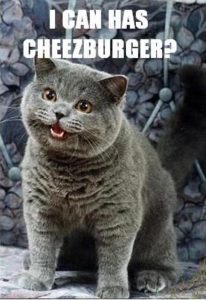
Meme (noun)
/mi:m/
“A virtually transmitted cultural symbol or social idea”.
Frankly, if you’ve been within 10 metres of a computer in the last five years, you’ll be familiar with the concept of ‘meme’. Despite the rather grandiose definition provided above, memes are realistically universally recognised as a crudely captured screengrab, with overlaid, block text:
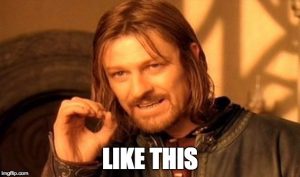
It’s pretty much impossible to spend any time online in 2017 without memes cropping up as visual references, social content, or the final word on passive aggressive arguments in niche reddit threads. So I’m told anyway. But how did memes come to dominate online communication like this? And what are the implications of such dominance?
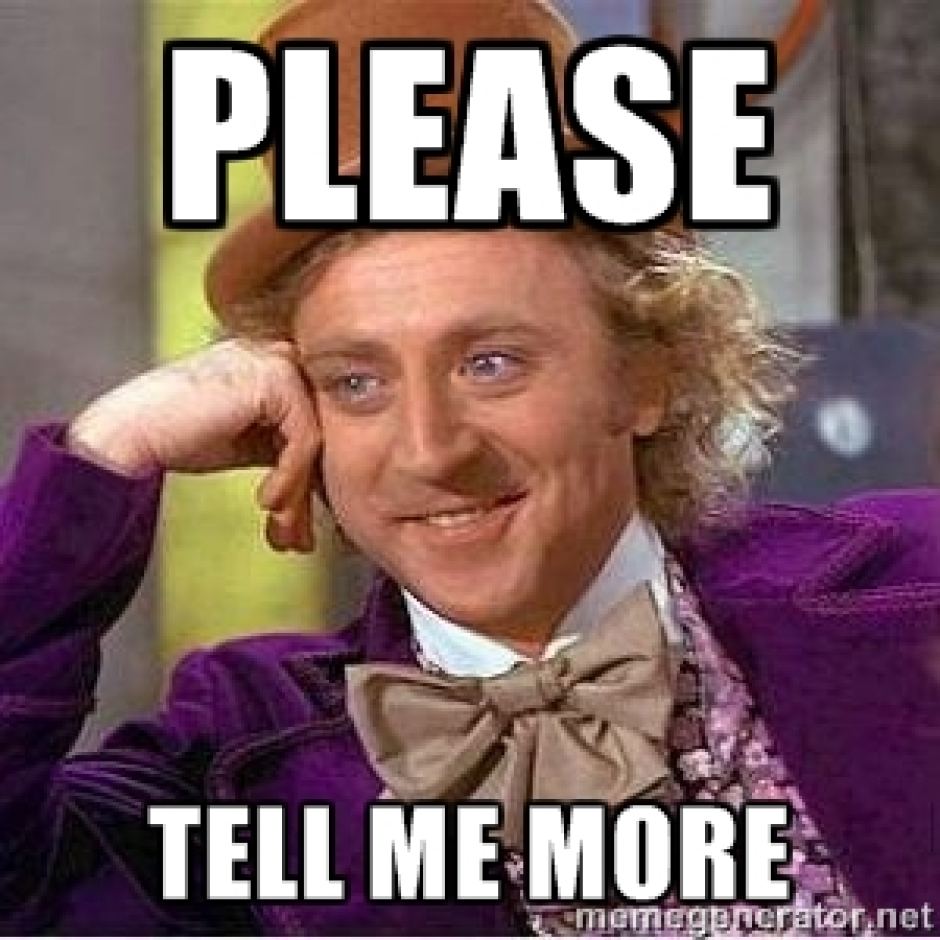
To answer this, let’s take it back. Back to 1976 to be precise, when ‘social media’ meant discussing the tabloid headlines over a pint, and ‘www’ was a typewriter typo. Evolutionary biologist and everyone’s favourite atheist, Richard Dawkins, first coined the term ‘meme’ as part of his work. His definition has its roots in the Greek word ‘mimema’, which simply means ‘something imitated’, and this is as good a place as any to start decoding the influence of memes themselves. Just as Dawkins describes, memes imitate. They imitate themselves, they imitate human behaviour, and, most importantly, they imitate life. This is where their power lies, because imitation and relatability creates community.
In today’s world, community no longer means lending your next-door neighbour an egg and a pint of milk, or attending a summer fete at the local church hall. Community now is online. It comes in the form of social media followings, Tumblr comments and, for some, threads of cat pictures. It is in these online community spaces where memes first began to, and indeed still do thrive. The thing about being online, is that communication is through the written word, with no facial expressions or body language to accompany it. Memes fill this gap perfectly, as a visual aid to conveying an emotion or sentiment. Each meme is already imbued with meaning, and doesn’t need decoding – this can connect two people on opposite sides of the planet within seconds, as long as they can both relate to it.
This is surely a good thing right? Memes provide a common source of understanding, and, for the most part, humour. It’s been pointed out on numerous occasions that the power of the meme is even more far reaching than this, with many claiming that memes give influence and voice to those who may not otherwise have it. For example, in a recent Guardian article, Douglas Haddow outlines how “it is now possible for Darryl from Accounting […] to have the same communicative power as a television network” due to the force of the meme. Similarly, a study from Texas University found that socially isolated individuals with little influence are more likely to create a successful meme than those more naturally socially adept. In the sphere of online communication whereby speed is the name of the game, a carefully curated Game of Thrones meme can make a point infinitely faster and with more impact than toiling over a keyboard. Haddow highlights this – “the faster you can grasp a point, the higher the chance it will spread” e.g. if the meme you post is clear and easily understood, you’ll be heard. This essentially takes influence and audience from the traditionally powerful, and gives it to whoever can load knowyourmeme.com first.
The power of the meme really comes alive however, when we consider this seal:

(Stick with me guys)
This is a seal pup. He knows nothing of the human experience. But how many human emotions and human situations has he conveyed during his life as a meme, purely because we can all relate to his wrinkled up little face?
As with most things that provide an alternative to authentic human interaction however, memes have their downsides. The very fact that memes give voice to people is also the reason they can be dangerous – they are reductive. In order to be understood and relatable to the largest amount of people, memes simplify often complex topics. Nowhere is this more apparent than in the political sphere, the latest US election as a prime example:

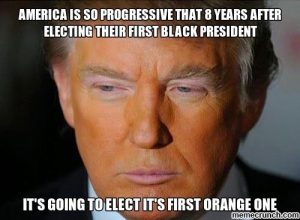
When images like these have characterised the most important democratic process in the free world, it might be time to take stock. Memes make it incredibly easy to reduce information to easily digestible chunks, and, whilst doing so, removing important nuance. Why should we bother forming our own thoughts into a well-balanced argument when a still from Parks and Recreation with overlaid text does it for us in a fraction of the time? This can lead to, at best, misunderstandings, and at worst, ignorant hostility.
So are memes a sinister, damaging phenomenon, or an endless source of fun that connects online users and builds relationships? Well folks, they’re probably both.
In the meme-time, I’ll just leave this here.